

By: Seungil Yoo, KGGTF 2026 Youth Intern
On January 20, as part of the third KGGTF Youth Internship Program, Richard Damania, Chief Economic Advisor of the World Bank presented key insights from the World Bank’s report Reboot Development: The Economics of a Livable Planet, offering a comprehensive overview of how economic development and environmental sustainability are deeply intertwined.
The lecture began by reflecting on the remarkable progress achieved over recent decades. Global poverty rates have fallen dramatically, child mortality has declined, and access to electricity and clean water has expanded worldwide. By conventional economic indicators, living standards have improved at an unprecedented pace. However, he emphasized that this progress has come at a significant environmental cost, placing increasing pressure on the planet’s natural systems.
A central theme of the lecture was the concept of planetary boundaries and their relevance to development economics. Drawing on recent scientific evidence, the speaker explained that humanity has already exceeded several safe ecological thresholds related to land use, air quality, water systems, biodiversity, and climate. These environmental stresses, the lecture argued, should not be viewed as secondary or purely environmental concerns, but rather as binding economic constraints, particularly for low-income countries.
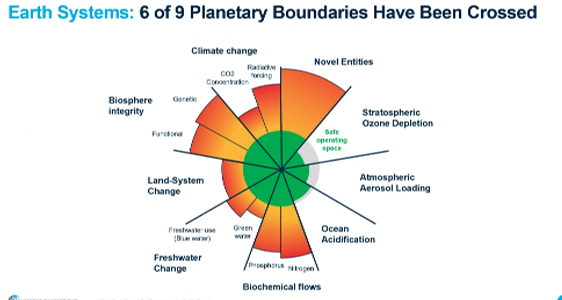
Focusing on land, air, and water as foundational inputs for development, the lecture highlighted stark global disparities. In many low-income countries, a large share of the population faces degraded land, polluted air, and insufficient water simultaneously, making sustained economic development extremely difficult. He emphasized that this reality challenges the traditional notion that countries can “grow first and clean up later,” a pathway that is increasingly unavailable in today’s global context.
He also presented emerging research on forests and hydrology to illustrate how environmental degradation translates directly into economic losses. Forests play a crucial role in regulating rainfall and maintaining soil moisture, which in turn affects agricultural productivity and hydropower potential. Large-scale deforestation, therefore, can reduce crop yields, weaken energy systems, and slow economic growth, often far beyond the immediate area where deforestation occurs. Importantly, the lecture emphasized that natural forests provide these benefits in ways that plantation forests do not, underscoring the economic value of ecosystem quality, not just quantity.

Despite the previous diagnosis, the lecture offered a cautiously optimistic outlook. Evidence from around the world suggests that economic growth can be decoupled from environmental degradation. Improvements in production efficiency, changes in consumption patterns, and well-designed policies can offset the environmental impacts of scale. China’s experience in rapidly reducing air pollution since 2014, without sacrificing economic growth, was highlighted as a powerful example of what is possible with strong policy commitment and investment.
The lecture concluded by emphasizing the role of policy, particularly industrial policy, and incentives in enabling green transitions. While supply-side support has successfully reduced the cost of clean technologies such as solar power, demand-side measures are also necessary to accelerate adoption. Sustainable development, the speaker stressed, will not be driven by a single policy tool, but by coordinated efforts that align economic growth, environmental protection, and long-term resilience.